History
The history of the Düden Waterfall
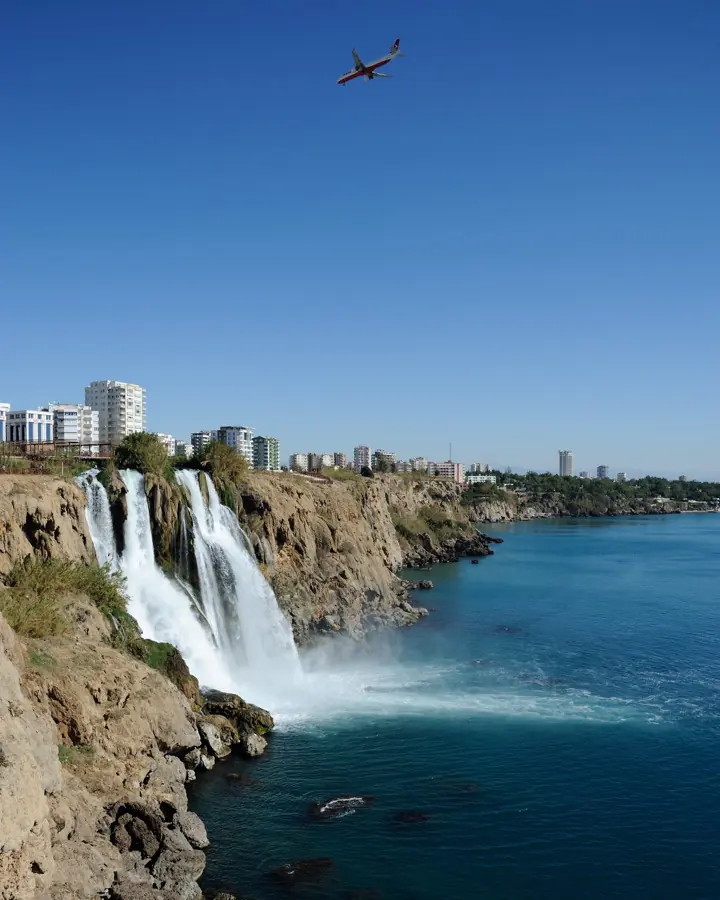
People have been writing about this waterfall for two thousand years. In antiquity it was the Katarrhaktes, and one of the earliest descriptions of it is in Strabo’s Geography. What he describes is the thing you stand at the cliff edge and look at today.
What Strabo wrote
In the fourteenth book of the Geography, Strabo works along the coast of Pamphylia from west to east. He names Olbia, then the river Katarrhaktes, then Attaleia. What he says about the waterfall is short, and oddly still accurate: it comes down from a lofty rock with such force that the noise is heard from far off.
There is a gap in that description. William Smith’s Dictionary of Greek and Roman Geography, published in 1857, points it out: it is generally assumed that Strabo means the water falls over the rock into the sea, but he never writes that. So the ancient text gives us the sound and the height, and withholds the sea.
Strabo is not the only source. Ptolemy names the Katarrhaktes, and so does Pliny the Elder. Their orderings do not agree with one another, which is why the positions of these towns were argued over for a long time.
Katarrhaktes, cataract
The Greek katarráktēs means rushing down. It entered Latin as cataracta and spread from there into western languages. That is why a great waterfall is called a cataract in English. The eye condition shares the root: something that comes down in front of the sight.
So the ancient name of this one waterfall became the name of a whole class of them.
The waterfall and the city named on one page
Attaleia, the place Strabo names straight after the Katarrhaktes, is modern Antalya. The city was founded by Attalus II Philadelphus of Pergamum and carries his name. Adalia, Attalia, Antalya are all continuations of it.
That leaves a small, pleasing result: the name of the city and the name of the waterfall appear one after the other in the same ancient text. Coming to Antalya, you see two things that were already written side by side two thousand years ago.
The falls did not stay put
This is the most interesting part. Smith’s dictionary reports the observation of Francis Beaufort, the naval surveyor who worked this coast in the nineteenth century: the two small rivers west of the town glided quietly into the sea across the sandy beach and could in no way answer the description of the Katarrhaktes. Meanwhile many small streams, the ones turning the mills, rushed straight over the cliff into the sea.
The same record adds a detail: the water of those streams was full of calcareous particles, and stalactites were seen near some of the mouths. Smith draws the conclusion: the lower course of the river has very probably changed greatly since Strabo’s time, and the changes are still going on.
The reason is in the water itself. Water off karst country carries lime, leaves it where it falls and builds its own rock over time. The cliff edge is not a fixed line. The waterfall makes its own sill, then wears it away.
Frequently asked questions
What was the Düden Waterfall called in antiquity?
Katarrhaktes. The Greek katarráktēs means rushing down. It passed into Latin as cataracta and from there into western languages. The English word cataract and the ancient name of this waterfall share one root.
Who wrote about the waterfall in antiquity?
Strabo. In the fourteenth book of his Geography, describing the coast of Pamphylia, he names Olbia, then the river Katarrhaktes, then Attaleia. Ptolemy and Pliny the Elder also mention the river.
What does Strabo say about it?
That it falls from a high rock and that the noise carries a long way. He does not actually say it falls into the sea. William Smith’s 1857 geographical dictionary makes the point: it is generally assumed that Strabo means it falls over a rock into the sea, but he does not say so.
Where does the name Antalya come from?
From Attaleia. The city was founded by Attalus II Philadelphus, king of Pergamum, and carries his name. Strabo lists the waterfall and the city in the same passage, so the two enter the record together.
Was the waterfall in the same place in antiquity?
Probably not exactly. Smith’s dictionary states that the lower course of the river has very probably undergone great changes since Strabo’s time, and that those changes are still going on. The reason is the lime in the water: the river builds its own rock.
There is an Alexander story too
Upper Düden is locally also called the Alexander Waterfall. That it is a local tradition rather than a documented record is something we set out on the Upper Düden page.
Last reviewed: 2 August 2026
Sources: Strabo, Geography 14.4.1 · William Smith, Dictionary of Greek and Roman Geography (1857), “Attaleia”
